
Engineering note: this guide is general information, not project-specific structural design. Use current product data, the applicable code and the responsible engineer’s assessment.
Begin with behaviour, not a sales headline
The useful question is not whether GFRP or steel is universally better. It is which reinforcement system fits the element, exposure, performance criteria, approvals and execution plan.
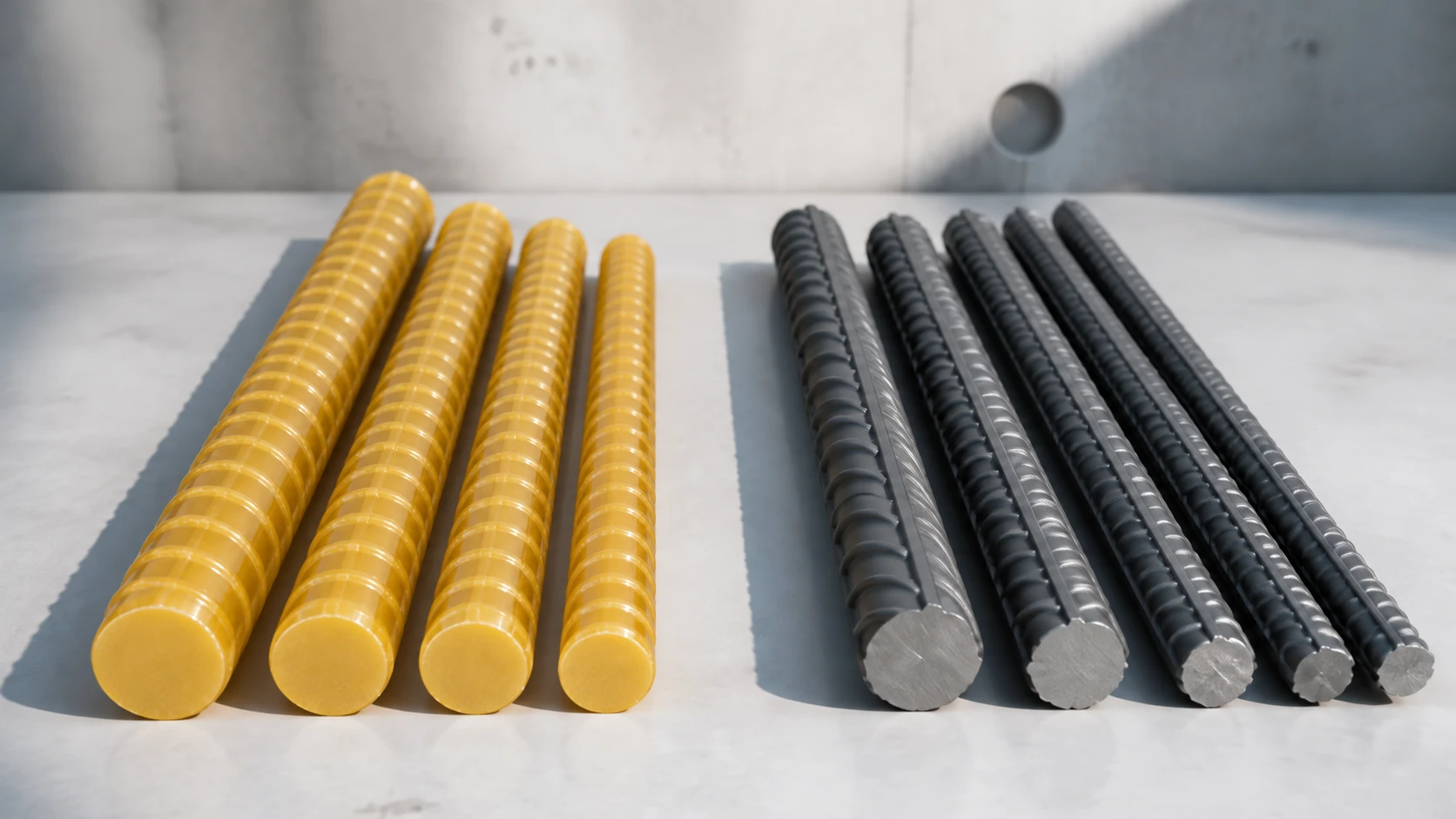
Steel is conductive, magnetic, relatively heavy and vulnerable to corrosion when protection is lost, but it is familiar, stiff, ductile and can often be fabricated on site. GFRP does not undergo electrochemical rust and is much lighter, non-magnetic and electrically non-conductive, but it has different stiffness and rupture behaviour. Those differences change design and detailing.
The six comparisons that matter
Corrosion exposure often starts the conversation, but it should not end it. Serviceability, fire, bond, detailing and construction practice can govern the design even when tensile capacity appears attractive.
- Corrosion: GFRP does not rust; steel needs an effective durability strategy
- Weight: GFRP can reduce manual handling and transport load
- Stiffness: steel is substantially stiffer; GFRP serviceability checks matter
- Failure behaviour: steel yields; GFRP remains linear-elastic to rupture
- Electromagnetism: GFRP is non-magnetic and non-conductive
- Fabrication: GFRP bends are normally factory coordinated, not field heat-bent
Why diameter-for-diameter substitution is risky
A bar is not selected from tensile strength alone. Bar spacing, reinforcement ratio, crack control, deflection, development and lap length, shear behaviour, environmental reduction and construction tolerances belong in the calculation. Replacing a steel schedule with the same GFRP diameters can therefore be unsafe or uneconomic.
ACI’s GFRP code addresses strength, serviceability, durability, development, splicing, inspection and testing. Bridge work may also use the applicable AASHTO framework. The responsible engineer should state the governing basis and use current manufacturer values that match the supplied bar.
Use lifecycle cost without hiding assumptions
A fair comparison considers delivered quantity, transport, lifting, installation, protective measures, inspection, future corrosion repairs, disruption and access - not only purchase rate. Results should be shown as scenarios rather than guaranteed savings.
SGF’s calculator is an editable estimation aid. It is not a structural design or a promise of savings. Uploading the project BOQ and bar schedule is the best route to a project-specific quotation.
Technical references
Use the latest edition applicable to the project. External references are provided for engineering context.
ACI GFRP resourcesFHWA FRP composite technology