
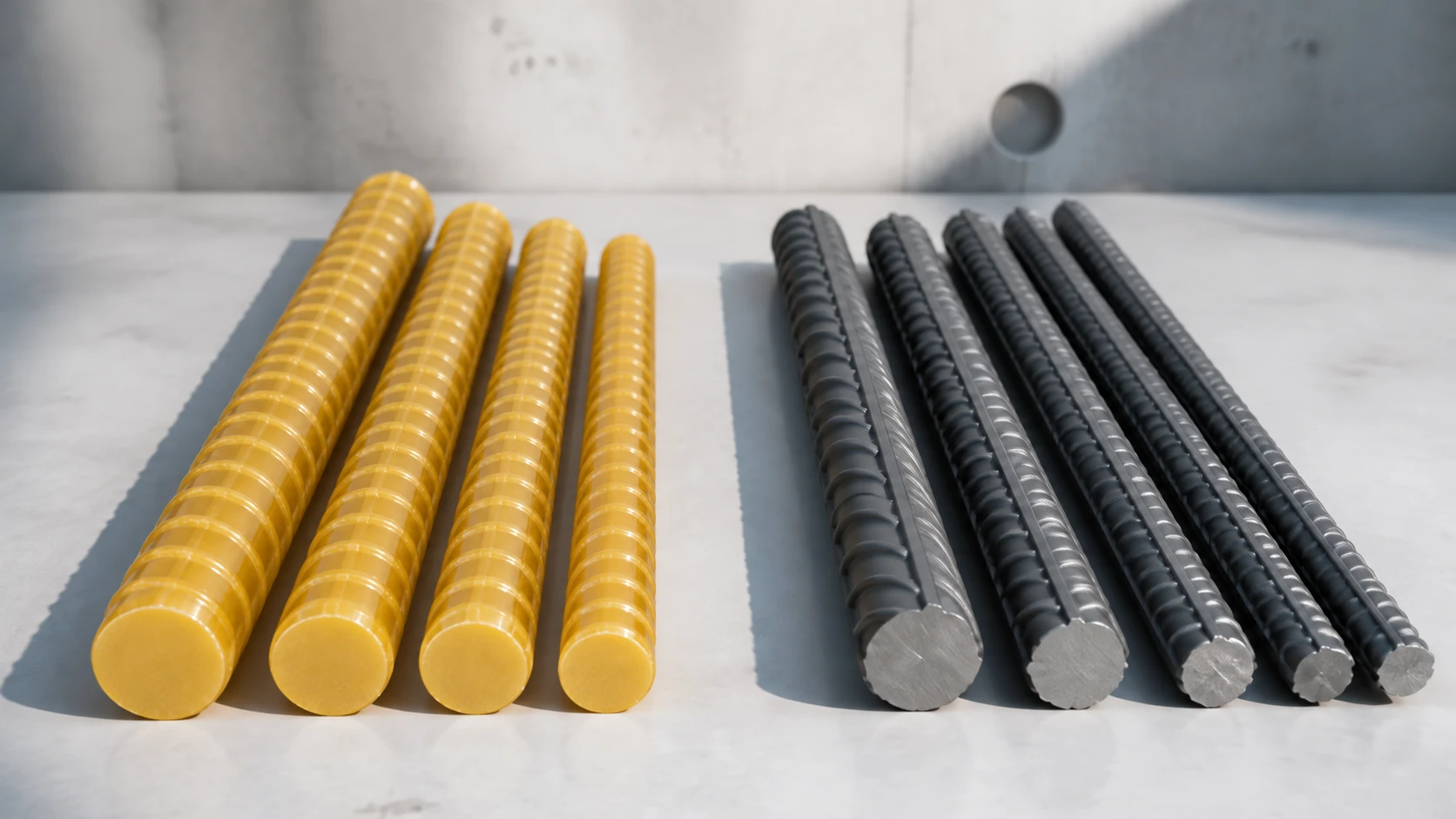
Compare the whole behaviour - not one headline number.
The reinforcement decision combines exposure, strength, stiffness, failure mode, constructability, approvals and whole-life cost.
What changes when the material changes.
These distinctions are useful at concept stage. The approved design must use current values for the actual bar supplied.
| Decision factor | GFRP rebar | Steel rebar |
|---|---|---|
| Corrosion | Will not rust | Requires protection in aggressive exposure |
| Weight | About one-quarter of steel | Higher handling weight |
| Electromagnetism | Non-magnetic and non-conductive | Conductive and magnetic |
| Tensile behaviour | High tensile strength; linear-elastic | Ductile yielding behaviour |
| Elastic modulus | Lower than steel; serviceability may govern | Higher stiffness |
| Failure mode | No yield plateau; brittle rupture must be designed for | Usually yields before rupture |
| Field fabrication | Do not heat-bend; coordinate factory-made shapes | Commonly cut and bent with approved site methods |
| Thermal response | Low thermal conductivity; resin limits still apply | High thermal conductivity |
| Density | Approximately 1.9–2.1 t/m³ | Approximately 7.8–7.9 t/m³ |
| Lifecycle focus | Can reduce corrosion-driven interventions | Durability depends on cover, environment and protection |
| Design approach | Use GFRP-specific codes and data | Familiar steel design conventions |
This is a material-selection aid, not a structural design table. GFRP must not be substituted diameter-for-diameter without a project-specific engineering design.
The supplied BOOK SGF brochure contains the values below. They are reproduced to complete the requested comparison, but they must be checked against current SGF product data, test method, specimen, environmental factors and the governing design standard before use.
Indicative mechanical-property table.
| Property | SGF GFRP | Metal rebar |
|---|---|---|
| Tensile strength | 1000+ MPa | 500–600 MPa |
| Shear strength | ≥150 MPa | 120 MPa |
| Bond strength | ≥11 MPa | 14 MPa* |
| Compression | 450 MPa | 500 MPa |
| Elastic modulus | ≥50 GPa | 160–200 GPa |
| Elongation | ≥1.5% | 25% |
| Density | 1.9 t/m³ | 7.8 t/m³ |
| Electrical behaviour | Dielectric | Electrically conductive |
The brochure also states “80 years+” durability. That wording is not treated here as a service-life warranty. Service life depends on design, exposure, material qualification, construction and verification.
Strength alone cannot select a bar.
Serviceability
Lower GFRP stiffness can make deflection and crack-width checks decisive.
Failure behaviour
GFRP remains linear-elastic to rupture; steel normally provides a yield stage.
Durability
No electrochemical rust does not remove the need to evaluate resin, temperature, fire and environment.
Detailing
Development, laps, bends, shear and factory geometry follow GFRP-specific rules.
A historical comparison - not a substitution schedule.
The brochure pairs the following 12 m bar weights. It describes the values as approximate and based on equal ultimate stress.
| GFRP diameter | GFRP / 12 m | Compared steel diameter | Steel / 12 m |
|---|---|---|---|
| 4.5 mm | 0.468 kg | 6 mm | 2.75 kg |
| 6 mm | 0.570 kg | 8 mm | 4.74 kg |
| 7 mm | 0.900 kg | 10 mm | 7.40 kg |
| 8 mm | 1.200 kg | 12 mm | 10.65 kg |
| 10 mm | 1.600 kg | 14 mm | 14.52 kg |
| 12 mm | 2.400 kg | 16 mm | 18.93 kg |
| 14 mm | 3.240 kg | 18 mm | 24.00 kg |
| 16 mm | 4.870 kg | 22 mm | 35.76 kg |
| 18 mm | 6.280 kg | 25 mm | 46.22 kg |
| 20 mm | 8.080 kg | 28 mm | 58.02 kg |
| 22 mm | 9.800 kg | 32 mm | 75.79 kg |
| 25 mm | 11.670 kg | 40 mm | 118.52 kg |
Ultimate strength equivalence does not prove equivalent stiffness, crack control, shear response, development, lap, fire performance or code compliance. Ask the responsible structural engineer to design each option separately.
Request current technical dataState the governing basis before comparing designs.
IS 18255:2023 covers FRP-bar test methods. IS 18256:2023 covers solid round GFRP bars for concrete reinforcement. Project adoption and design requirements must be confirmed by the approving engineer and authority.
Projects may also refer to ACI CODE-440.11-22, ASTM D7957/D7957M or an applicable bridge framework. Editions and scope must match the project.
Use current product data and test documents that identify the tested sample, method, date and certificate scope. A company-level credential is not automatically a product approval.
Let’s review your reinforcement requirement.
Share your drawings, quantities or application. Our team will help define the right next step.